Tuesday, November 17, 2009
Space Shuttle
The Space Shuttle, part of the Space Transportation System (STS), is a spacecraft operated by NASA for orbital human spaceflight missions. It began operations in 1982 and is scheduled to be retired from service in 2010 after 134 launches. Major missions have included launching numerous satellites and interplanetary probes, conducting space science experiments, and servicing and construction of space stations. The Shuttle has been used for orbital space missions by NASA, the U.S. Department of Defense, the European Space Agency, and Germany. The United States funded STS development and shuttle operations.
At launch, Space Shuttle consists of a dark orange-colored external tank (ET);[1][2] two white, slender Solid Rocket Boosters (SRBs); and the STS Orbiter Vehicle (OV) which contains the crew and payload. Payloads can be launched into higher orbits with either of two different booster stages developed for STS (1 stage PAM or 2 stage IUS).
The shuttle stack launches vertically like a conventional rocket from a mobile launch platform. It lifts off under the power of its two solid rocket boosters (SRBs) and its three main engines (SSMEs), the latter fueled by liquid hydrogen and liquid oxygen from the external tank. The space shuttle has a two stage ascent. The boosters are used only for the first stage, while the main engines burn for both stages. About two minutes after liftoff, staging occurs: the SRBs are released, and shortly begin falling into the ocean to be retrieved for reuse. The shuttle orbiter and external tank continue to ascend under power from the three main engines and their inertia. Upon reaching orbit, the main engines are shut down, and the external tank is jettisoned downward and falls to burn up in the atmosphere. However, it is possible for it be re-used in orbit for various applications.[3] At this point, the orbital maneuvering system (OMS) engines may be used to adjust or circularize the achieved orbit.
The orbiter carries astronauts and payload such as satellites or space station parts into low earth orbit, into the Earth's upper atmosphere or thermosphere.[4] Usually, five to seven crew members ride in the orbiter. Two crew members, the Commander and Pilot, are sufficient for a minimal flight, as in the first four "test" flights, STS-1 through STS-4. A typical payload capacity is about 22,700 kilograms (50,000 lb), but can be raised depending on the choice of launch configuration. The orbiter carries the payload in a large cargo bay with doors that open along the length of its top, a feature which makes the space shuttle unique among present spacecraft. This feature made possible the deployment of large satellites such as the Hubble Space Telescope, and also to capture and return large payloads back to Earth.
When the orbiter's space mission is complete it fires its Orbital Maneuvering System (OMS) thrusters to drop out of orbit and re-enter the lower atmosphere. During the descent, the shuttle orbiter passes through different layers of the atmosphere and decelerates from hypersonic speed primarily by aerobraking. In the lower atmosphere and landing phase, it acts as a glider with reaction control system (RCS) thrusters and fly-by wire controlled hydraulically actuated flight surfaces controlling its descent. It then makes a landing on a long runway as a spaceplane. The aerodynamic shape is a compromise between the demands of radically different speeds and air pressures during re-entry, subsonic atmospheric flight, and hypersonic flight. As a result the orbiter has a high sink rate at low altitudes, and transitions from using RCS thrusters in low pressure to flight surfaces at low altitudes.
Source: Wikipedia
Labels:
nasa,
space exploration system,
space shuttle
Monday, November 16, 2009
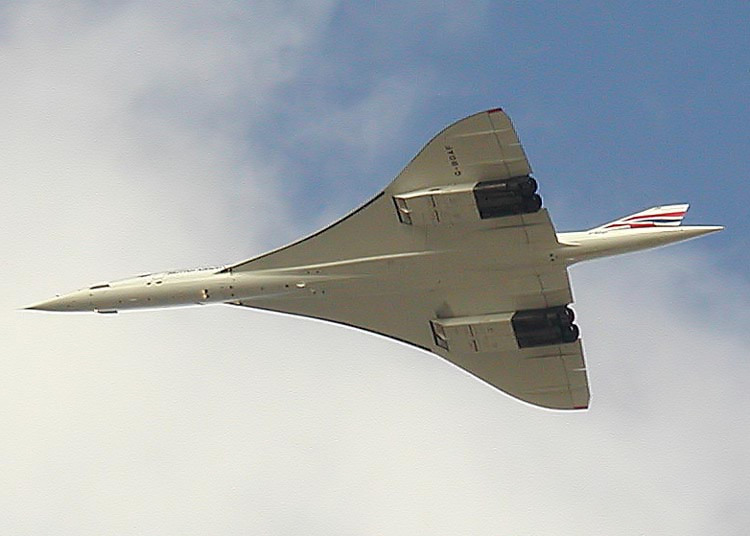
Supersonic Aircraft
The Concorde supersonic transport had an ogival delta wing, a slender fuselage and four underslung Rolls-Royce/Snecma Olympus 593 engines.
A supersonic transport (SST) is a civil supersonic aircraft designed to transport passengers at speeds greater than the speed of sound. The only SST to see regular service were Concorde and the Tupolev Tu-144. The last passenger flight of the Tu-144 was in June 1978, and Concorde's last flight was on November 26, 2003. The last regular passenger flights landed at Heathrow Airport on Friday, October 24, 2003 just past 4 p.m. - flight 002 from New York, one from Edinburgh, Scotland, and the third which had taken off from Heathrow on a loop flight over the Bay of Biscay. Following the permanent cessation of flying by all Concorde, there are no SSTs in commercial service.
Supersonic airliners are significantly heavier, less aerodynamic, create sonic booms and have lower range and cost more for travel than subsonic airliners. While supersonic jet engines are rather more efficient per mile, the net efficiency of the aircraft is lower and cost per seat rather higher.
Nevertheless, Concorde was operated profitably in a niche market for over 25 years.
Source: Wikipedia
The Earth
Space exploration has been used as a tool to understand the Earth as a celestial object in its own right. Orbital missions can provide data for the Earth that can be difficult or impossible to obtain from a purely ground-based point of reference.
For example, the existence of the Van Allen belts was unknown until their discovery by the United States' first artificial satellite, Explorer 1. These belts contain radiation trapped by the Earth's magnetic fields, which currently renders construction of habitable space stations above 1000 km impractical. Following this early unexpected discovery, a large number of Earth observation satellites have been deployed specifically to explore the Earth from a space based perspective. These satellites have significantly contributed to the understanding of a variety of earth based phenomena. For instance, the hole in the ozone layer was found by an artificial satellite that was exploring Earth's atmosphere, and satellites have allowed for the discovery of archeological sites or geological formations that were difficult or impossible to otherwise identify.
Source: Wikipedia
Labels:
artificial satellite,
atmosphere,
ozone layer
Venus was the first target of interplanetary flyby and lander missions and, despite one of the most hostile surface environments in the solar system, has had more landers sent to it (nearly all from the Soviet Union) than any other planet in the solar system. The first successful Venus flyby was the American Mariner 2 spacecraft, which flew past Venus in 1962. Mariner 2 has been followed by several other flybys by multiple space agencies often as part of missions using a Venus flyby to provide a gravitational assist en route to other celestial bodies. In 1967 Venera 4 became the first probe to enter and directly examine the atmosphere of Venus. In 1970 Venera 7 became the first successful lander to reach the surface of Venus and by 1985 it had been followed by eight additional successful Soviet Venus landers which provided images and other direct surface data. Starting in 1975 with the Soviet orbiter Venera 9 some ten successful orbiter missions have been sent to Venus, including later missions which were able to map the surface of Venus using radar to pierce the obscuring atmosphere.
Source: Wikipedia
Labels:
celestial bodies,
interplanetary flyby,
venera 9
Mercury
Mercury remains the least explored of the inner planets. As of January 2008, the Mariner 10 and MESSENGER missions have been the only missions that have made close observations of Mercury. MESSENGER made a fly-by of Mercury on 14 January 2008, to further investigate the observations made by Mariner 10 in 1975 (Munsell, 2006b). A third mission to Mercury, scheduled to arrive in 2020, BepiColombo is to include two probes. BepiColombo is a joint mission between Japan and the European Space Agency. MESSENGER and BepiColombo are intended to gather complementary data to help scientists understand many of the mysteries discovered by Mariner 10's flybys.
Flights to other planets within the Solar System are accomplished at a cost in energy, which is described by the net change in velocity of the spacecraft, or delta-v. Due to the relatively high delta-v to reach Mercury and its proximity to the Sun, it is difficult to explore and orbits around it are rather unstable.
Labels:
mariner 10,
messenger missions
The Sun
While the Sun will probably not be physically explored in the close future, one of the reasons for going into space includes knowing more about the Sun. Once above the atmosphere in particular and the Earth's magnetic field, this gives access to the Solar wind and infrared and ultraviolet radiations that cannot reach the surface of the Earth. The Sun generates most space weather, which can affect power generation and transmission systems on Earth and interfere with, and even damage, satellites and space probes.
Labels:
ultraviolet radiation
Astrobiology
Astrobiology is the interdisciplinary study of life in the universe, combining aspects of astronomy, biology and geology.[11] It is focused primarily on the study of the origin, distribution and evolution of life. It is also known as exobiology (from Greek: έξω, exo, "outside"). The term "Xenobiology" has been used as well, but this is technically incorrect because its terminology means "biology of the foreigners". Astrobiologists must also consider the possibility of life that is chemically entirely distinct from any life found on earth.
Source: Wikipedia
Source: Wikipedia
Labels:
astrobiologists
Subscribe to:
Posts (Atom)