The Space Shuttle, part of the Space Transportation System (STS), is a spacecraft operated by NASA for orbital human spaceflight missions. It began operations in 1982 and is scheduled to be retired from service in 2010 after 134 launches. Major missions have included launching numerous satellites and interplanetary probes, conducting space science experiments, and servicing and construction of space stations. The Shuttle has been used for orbital space missions by NASA, the U.S. Department of Defense, the European Space Agency, and Germany. The United States funded STS development and shuttle operations.
At launch, Space Shuttle consists of a dark orange-colored external tank (ET);[1][2] two white, slender Solid Rocket Boosters (SRBs); and the STS Orbiter Vehicle (OV) which contains the crew and payload. Payloads can be launched into higher orbits with either of two different booster stages developed for STS (1 stage PAM or 2 stage IUS).
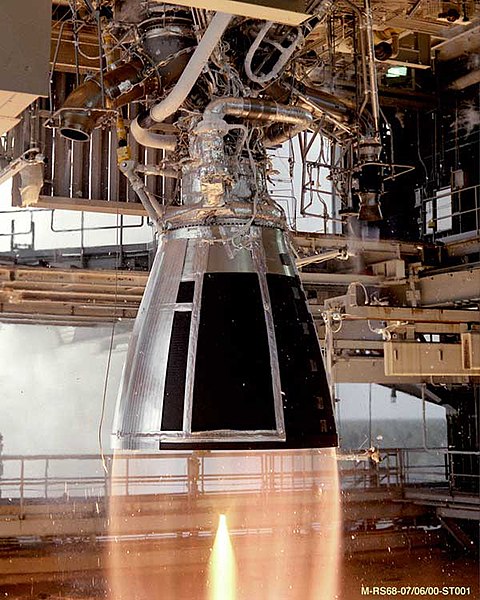
The shuttle stack launches vertically like a conventional rocket from a mobile launch platform. It lifts off under the power of its two solid rocket boosters (SRBs) and its three main engines (SSMEs), the latter fueled by liquid hydrogen and liquid oxygen from the external tank. The space shuttle has a two stage ascent. The boosters are used only for the first stage, while the main engines burn for both stages. About two minutes after liftoff, staging occurs: the SRBs are released, and shortly begin falling into the ocean to be retrieved for reuse. The shuttle orbiter and external tank continue to ascend under power from the three main engines and their inertia. Upon reaching orbit, the main engines are shut down, and the external tank is jettisoned downward and falls to burn up in the atmosphere. However, it is possible for it be re-used in orbit for various applications.[3] At this point, the orbital maneuvering system (OMS) engines may be used to adjust or circularize the achieved orbit.
The orbiter carries astronauts and payload such as satellites or space station parts into low earth orbit, into the Earth's upper atmosphere or thermosphere.[4] Usually, five to seven crew members ride in the orbiter. Two crew members, the Commander and Pilot, are sufficient for a minimal flight, as in the first four "test" flights, STS-1 through STS-4. A typical payload capacity is about 22,700 kilograms (50,000 lb), but can be raised depending on the choice of launch configuration. The orbiter carries the payload in a large cargo bay with doors that open along the length of its top, a feature which makes the space shuttle unique among present spacecraft. This feature made possible the deployment of large satellites such as the Hubble Space Telescope, and also to capture and return large payloads back to Earth.
When the orbiter's space mission is complete it fires its Orbital Maneuvering System (OMS) thrusters to drop out of orbit and re-enter the lower atmosphere. During the descent, the shuttle orbiter passes through different layers of the atmosphere and decelerates from hypersonic speed primarily by aerobraking. In the lower atmosphere and landing phase, it acts as a glider with reaction control system (RCS) thrusters and fly-by wire controlled hydraulically actuated flight surfaces controlling its descent. It then makes a landing on a long runway as a spaceplane. The aerodynamic shape is a compromise between the demands of radically different speeds and air pressures during re-entry, subsonic atmospheric flight, and hypersonic flight. As a result the orbiter has a high sink rate at low altitudes, and transitions from using RCS thrusters in low pressure to flight surfaces at low altitudes.
Source: Wikipedia