Showing posts with label airplane engine. Show all posts
Friday, November 13, 2009
Turboprop Aircraft Engine
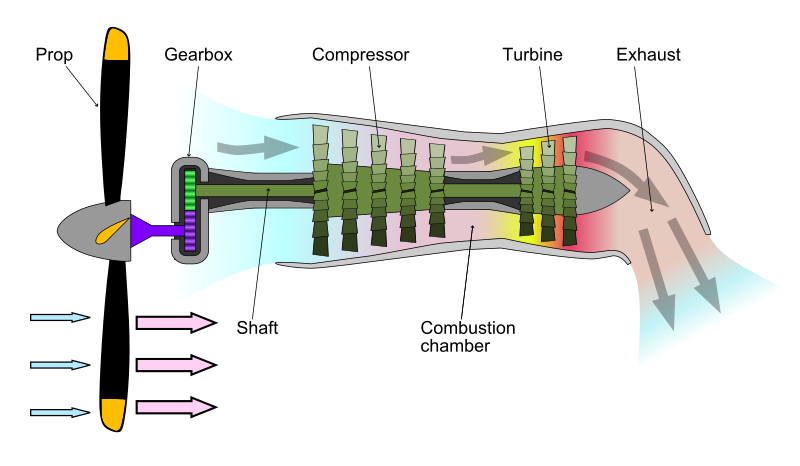
Turboprop engines are a type of aircraft powerplant that use a gas turbine to drive a propeller. The gas turbine is designed specifically for this application, with almost all of its output being used to drive the propeller. The engine's exhaust gases contain little energy compared to a jet engine and play a minor role in the propulsion of the aircraft.
The propeller is coupled to the turbine through a reduction gear that converts the high RPM, low torque output to low RPM, high torque. The propeller itself is normally a constant speed (variable pitch) type similar to that used with larger reciprocating aircraft engines.
Turboprop engines are generally used on small subsonic aircraft, but some aircraft outfitted with turboprops have cruising speeds in excess of 500 kt (926 km/h, 575 mph). Large military and civil aircraft, such as the Lockheed L-188 Electra and the Tupolev Tu-95, have also used turboprop power.
In its simplest form a turboprop consists of an intake, compressor, combustor, turbine, and a propelling nozzle. Air is drawn into the intake and compressed by the compressor. Fuel is then added to the compressed air in the combustor, where the fuel-air mixture then combusts. The hot combustion gases expand through the turbine. Some of the power generated by the turbine is used to drive the compressor. The rest is transmitted through the reduction gearing to the propeller. Further expansion of the gases occurs in the propelling nozzle, where the gases exhaust to atmospheric pressure. The propelling nozzle provides a relatively small proportion of the thrust generated by a turboprop.
Turboprops are very efficient at modest flight speeds (below 450 mph) because the jet velocity of the propeller (and exhaust) is relatively low. Due to the high price of turboprop engines they are mostly used where high-performance short-takeoff and landing (STOL) capability and efficiency at modest flight speeds are required. The most common application of turboprop engines in civilian aviation is in small commuter aircraft, where their greater reliability than reciprocating engines offsets their higher initial cost.
Source: Wikipedia
Labels:
aircraft engine,
airplane engine,
turbo engine
Tuesday, November 3, 2009
Engine Design Considerations
The process of developing an engine is one of compromises. Engineers design specific attributes into engines to achieve specific goals. Aircraft are one of the most demanding applications for an engine, presenting multiple design requirements, many of which conflict with each other. An aircraft engine must be:
Reliable, as losing power in an airplane is a substantially greater problem than an automobile engine seizing. Aircraft engines operate at temperature, pressure, and speed extremes, and therefore need to operate reliably and safely under all these conditions.
Lightweight, as a heavy engine increases the empty weight of the aircraft & reduces its payload.
Powerful, to overcome the weight and drag of the aircraft.
small and easily streamlined; large engines with substantial surface area, when installed, create too much drag, wasting fuel and reducing power output.
Repairable, to keep the cost of replacement down. Minor repairs should be relatively inexpensive.
Fuel efficient, to give the aircraft the range the design requires.
capable of operating at sufficient altitude for the aircraft.
Unlike automobile engines, aircraft engines run at high power settings for extended periods of time. In general, the engine runs at maximum power for a few minutes during taking off, then power is slightly reduced for climb, and then spends the majority of its time at a cruise setting—typically 65% to 75% of full power. In contrast, a car engine might spend 20% of its time at 65% power accelerating, followed by 80% of its time at 20% power while cruising. The power of an internal combustion reciprocating or turbine aircraft engine is rated in units of power delivered to the propeller (typically horsepower) which is torque multiplied by crankshaft revolutions per minute (RPM). The propeller converts the engine power to thrust horsepower or thp in which the thrust is a function of the blade pitch of the propeller relative to the velocity of the aircraft. Jet engines are rated in terms of thrust, usually the maximum amount achieved during takeoff.
The design of aircraft engines tends to favor reliability over performance. Long engine operation times and high power settings, combined with the requirement for high-reliability means that engines must be constructed to support this type of operation with ease. Aircraft engines tend to use the simplest parts possible and include two sets of anything needed for reliability. Independence of function lessens the likelihood of a single malfunction causing an entire engine to fail. For example, reciprocating engines have two independent magneto ignition systems, and the engine's mechanical engine-driven fuel pump is always backed-up by an electric pump.
Aircraft spend the vast majority of their time travelling at high speed. This allows an aircraft engine to be air cooled, as opposed to requiring a radiator. With the absence of a radiator, aircraft engines can boast lower weight and less complexity. The amount of air flow an engine receives is usually carefully designed according to expected speed and altitude of the aircraft in order to maintain the engine at the optimal temperature.
Aircraft operate at higher altitudes where the air is less dense than at ground level. As engines need oxygen to burn fuel, a forced induction system such as turbocharger or supercharger is especially appropriate for aircraft use. This does bring along the usual drawbacks of additional cost, weight and complexity.
Labels:
aircraft engine,
airplane engine,
motor engine
Subscribe to:
Posts (Atom)