Friday, November 20, 2009
Hypersonic Speeds
In aerodynamics, hypersonic speeds are those that are highly supersonic. Since the 1970s, the term has generally been assumed to refer to speeds of Mach 5 (5 times the speed of sound) and above. The hypersonic regime is a subset of the supersonic regime.
The precise Mach number at which a craft can be said to be fully hypersonic is elusive, especially since physical changes in the airflow (molecular dissociation, ionization) occur at quite different speeds. Generally, a combination of effects become important "as a whole" around Mach 5. The hypersonic regime is often defined as speeds where ramjets do not produce net thrust. This is a nebulous definition in itself, as there exists a proposed change to allow them to operate in the hypersonic regime (the Scramjet).
Source: Wikipedia
Labels:
hypersonic,
hypersonic regime,
mach 5
Napier Sabre
Napier Sabre cutaway at the London Science Museum.
The Napier Sabre was a British 24-cylinder, liquid cooled, sleeve valve, piston aero engine, designed by Major Frank Halford and built by Napier & Son during WWII. The engine evolved to become one of the most powerful inline piston aircraft engines in the world developing from 2,200 horsepower (1,640 kW) in its earlier versions to 5,500 hp (4,100 kW) in late-model prototypes.
The first operational aircraft to be powered by the Sabre were the Hawker Typhoon and Hawker Tempest; however, the first aircraft powered by the Sabre was the Napier-Heston Racer, which was designed to capture the world speed record[nb 1]. Other aircraft using the Sabre were the Martin-Baker MB 3 and some versions of the Blackburn Firebrand and Hawker Fury. The rapid conversion to jet engines after the war led to the quick demise of the Sabre, as Napier also turned to jets.
Source: Wikipedia
Reaction Engines Skylon
The Skylon vehicle is an aircraft designed to reach orbit.
In aerospace, Skylon is a design by Reaction Engines Limited (managed by British rocket scientist Alan Bond) for an airbreathing single-stage to orbit, precooled air turborocket based spaceplane. A fleet of vehicles is envisaged; each vehicle would be reusable at least 200 times. Costs per kilogram of payload would be below the current costs of launch (as of 2006), including the costs of R&D, with costs expected to fall much more over time after the initial expenditures have amortised. The cost of the program, including production of a small fleet of aircraft has been estimated to be about $10 billion.
The vehicle would be a hydrogen-powered aircraft that would take off from a conventional runway, and accelerate to Mach 5.5 at 26 km before switching the rocket engine to internal LOX supply to take it to orbit. It would then release a 12-tonne payload, and reenter. The payload would be carried in a standard payload container.
During reentry the relatively light vehicle would fly back through the atmosphere and land back at the runway, with its skin protected by a strong ceramic. The vehicle would then undergo any necessary maintenance and would be able to fly again within 2 days.
The proposed engine for the vehicle is not a scramjet, but a precooled jet engine. Originally the key technology for this did not exist - the required heat exchanger was about ten times lighter than the state of the art. However, research has now achieved the necessary performance. Currently no funding to fully develop and build the vehicle exists, but research and development work is nevertheless ongoing, particularly on the engine.
Source: Wikipedia
Rocket Engines
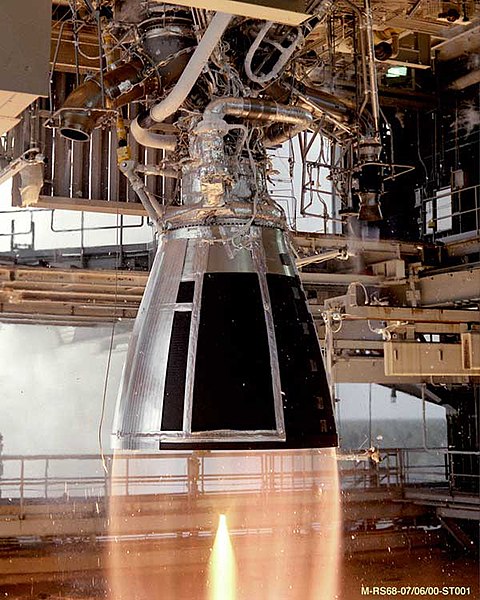
RS-68 being tested at NASA's Stennis Space Center. The nearly transparent exhaust is due to this engine's exhaust being mostly superheated steam (water vapor from its propellants, hydrogen and oxygen)
A rocket engine or simply "rocket" is a jet engine that uses only propellant mass for forming its high speed propulsive jet. Rocket engines are reaction engines and obtain thrust in accordance with Newton's third law. Since they need no external material to form their jet, rocket engines can be used for spacecraft propulsion as well as terrestrial uses, such as missiles. Most rocket engines are internal combustion engines, although non combusting forms also exist.
Rocket motor is a synonymous term that usually refers to solid rocket engines. Chemical rockets are rockets powered by exothermic chemical reactions of the propellant. Thermal rockets are rockets where the propellant is inert, but is heated by a power source such as solar or nuclear power.
Rocket engines as a group, have the highest exhaust velocities, are by far the lightest, and are the most energy efficient (at least at very high speed) of all types of jet engines. However, for the thrust they give, due to the high exhaust velocity and relatively low specific energy of rocket propellant, they consume propellant very rapidly.
Source : Wikipedia
Labels:
nasa,
rocket engines,
stennis space center
Wednesday, November 18, 2009
Milky Way Galaxy
The Milky Way, or simply the Galaxy, is the galaxy in which the Solar System is located. It is a barred spiral galaxy that is part of the Local Group of galaxies. It is one of billions of galaxies in the observable universe. Its name is a translation of the Latin Via Lactea, in turn translated from the Greek Γαλαξίας (Galaxias), referring to the pale band of light formed by the galactic plane as seen from Earth (see etymology of galaxy). Some sources hold that, strictly speaking, the term Milky Way should refer exclusively to the band of light that the galaxy forms in the night sky, while the galaxy should receive the full name Milky Way Galaxy, or alternatively the Galaxy. However, it is unclear how widespread this convention is, and the term Milky Way is routinely used in either context.
Source: Wikipedia
Labels:
galaxy,
milky way galaxy,
solar system
Interstellar Medium
In astronomy, the interstellar medium (or ISM) is the gas and dust that pervade interstellar space: the matter that exists between the star systems within a galaxy. It fills interstellar space and blends smoothly into the surrounding intergalactic space. The energy that occupies the same volume, in the form of electromagnetic radiation, is the interstellar radiation field.
The interstellar medium consists of an extremely dilute (by terrestrial standards) mixture of ions, atoms, molecules, larger dust grains, cosmic rays, and (galactic) magnetic fields. The matter consists of about 99% gas and 1% dust by mass. Densities range from a few thousand to a few hundred million particles[clarification needed] per cubic meter with an average value in the Milky Way Galaxy of a million particles per cubic meter (1 atom per cubic centimeter). The Sun, for example, is presently traveling through the Local Interstellar Cloud (0.1 atoms/cc), within the Local Bubble (0.05 atoms/cc). As a result of primordial nucleosynthesis, gas in the ISM is roughly 89% hydrogen and 9% helium and 2% elements heavier than hydrogen or helium by number of protons, with additional heavier elements ("metals" in astronomical parlance) present in trace amounts.
The ISM plays a crucial role in astrophysics precisely because of its intermediate role between stellar and galactic scales. Stars form within the densest regions of the ISM, molecular clouds, and replenish the ISM with matter and energy through planetary nebulae, stellar winds, and supernovae. This interplay between stars and the ISM helps determine the rate at which a galaxy depletes its gaseous content, and therefore its lifespan of active star formation.
Very Light Jet
A very light jet (VLJ), previously known as a microjet, is, by convention, a small jet aircraft approved for single-pilot operation, seating 4-8 people, with a maximum take-off weight of under 10,000 pounds (4,540 kg). They are lighter than what is commonly termed business jets and are designed to be flown by single pilot owners.
By late 2009 the term Very Light Jet had become so tainted by the "billion-dollar debacle" of Eclipse Aviation who trumpeted that term widely, that most manufacturers were avoiding use of the term to describe their products. The NBAA's Brian Foley explained "The term VLJ was at times tainted by...unrealistic expectations and even failure. The industry would do well to drop hyped words in order to improve credibility with users." Cessna never used the term to describe its Mustang, Embraer labels its Phenom 100 an "entry-level jet" and Stratos has described their jet as "not a VLJ...but a very light personal jet."
The Embraer Phenom 100 is not a very light jet, as its certified weight is 10,472 lbs. It is a light jet.
Source: Wikipedia
Labels:
light jet,
very light jet,
very light personal jet
Subscribe to:
Posts (Atom)