Wednesday, November 4, 2009
Turbofan Aircraft Engine
A turbofan engine is much the same as a turbojet, but with an enlarged fan at the front which provides thrust in much the same way as a propeller. A turbofan has extra turbine stages to turn the fan. Thus, more power is extracted from the exhaust gases before they leave the engine. This operation is a more efficient way to provide thrust than the jet nozzle alone, resulting in improved fuel-efficiency. Turbofans were the first engines to use multiple spools; concentric shafts which are free to rotate at their own speed; in order to allow the engine to react more quickly to changing power requirements. Although the fan creates thrust like a propeller, the surrounding duct frees it from many of the restrictions which limit propeller performance. Turbofans are more efficient than propellers in the trans-sonic range of aircraft speeds, and can operate in the supersonic realm. Turbofans are coarsely split into low-bypass and high-bypass categories. Bypass air flows through the fan, but around the jet core, not mixing with fuel and burning. The ratio of this air to the amount of air flowing through the engine core is the bypass ratio. Low-bypass engines are preferred for military applications such as fighters due to high thrust-to-weight ratio, while high-bypass engines are preferred for civil use for good fuel efficiency and low noise. High-bypass turbofans are usually most efficient when the aircraft is traveling at 500 to 550 miles per hour (800 to 885 km/h), the cruise speed of most large airliners. Low-bypass turbofans can reach supersonic speeds, though normally only when fitted with afterburners.
Source: Wikipedia
Labels:
jet engines,
turbofan engine,
turbofan machine
Turbojet
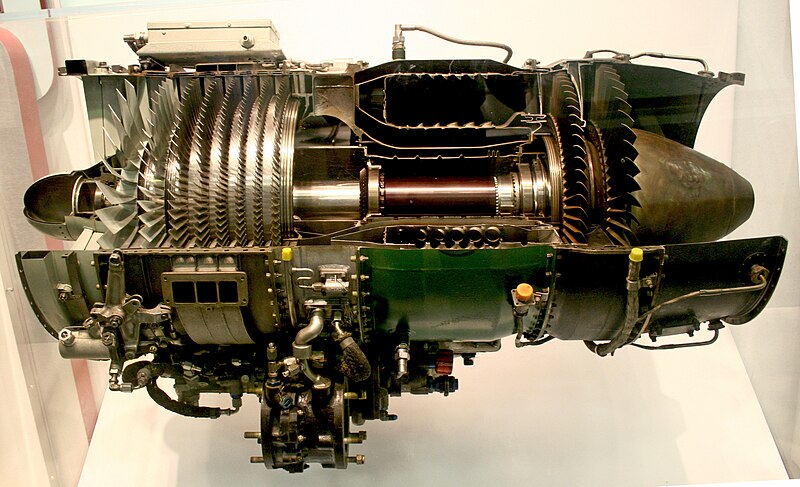
A General Electric J85-GE-17A turbojet engine. This cutaway clearly shows the 8 stages of axial compressor at the front (left side of the picture), the combustion chambers in the middle, and the two stages of turbines at the rear of the engine.
A turbojet is a type of gas turbine engine that was originally developed for military fighters during World War II. A turbojet is the simplest of all aircraft gas turbines. It features a compressor to draw air in and compress it, a combustion section which adds fuel and ignites it, one or more turbines that extract power from the expanding exhaust gases to drive the compressor, and an exhaust nozzle which accelerates the exhaust out the back of the engine to create thrust. When turbojets were introduced, the top speed of fighter aircraft equipped with them was at least 100 miles per hour faster than competing piston-driven aircraft. The relative simplicity of turbojet designs lent themselves to wartime production, but the war ended before any turbojets could be mass-produced. In the years after the war, the drawbacks of the turbojet gradually became apparent. Below about Mach 2, turbojets are very fuel inefficient and create tremendous amounts of noise. The early designs also respond very slowly to power changes, a fact which killed many experienced pilots when they attempted the transition to jets. These drawbacks eventually led to the downfall of the pure turbojet, and only a handful of types are still in production. The last airliner that used turbojets was the Concorde, whose Mach 2 flight crossed the threshold into efficient turbojet operation.
Source : Wikipedia.
A turbojet is a type of gas turbine engine that was originally developed for military fighters during World War II. A turbojet is the simplest of all aircraft gas turbines. It features a compressor to draw air in and compress it, a combustion section which adds fuel and ignites it, one or more turbines that extract power from the expanding exhaust gases to drive the compressor, and an exhaust nozzle which accelerates the exhaust out the back of the engine to create thrust. When turbojets were introduced, the top speed of fighter aircraft equipped with them was at least 100 miles per hour faster than competing piston-driven aircraft. The relative simplicity of turbojet designs lent themselves to wartime production, but the war ended before any turbojets could be mass-produced. In the years after the war, the drawbacks of the turbojet gradually became apparent. Below about Mach 2, turbojets are very fuel inefficient and create tremendous amounts of noise. The early designs also respond very slowly to power changes, a fact which killed many experienced pilots when they attempted the transition to jets. These drawbacks eventually led to the downfall of the pure turbojet, and only a handful of types are still in production. The last airliner that used turbojets was the Concorde, whose Mach 2 flight crossed the threshold into efficient turbojet operation.
Source : Wikipedia.
Labels:
A General Electric J85-GE-17A,
turbo jett,
turbojet
Jet Engines
The key part of a jet engine is the exhaust nozzle. This is the part which produces thrust for the jet; the hot airflow from the engine is accelerated when exiting the nozzle, creating thrust, which, in conjunction with the pressures acting inside the engine which are maintained and increased by the constriction of the nozzle, pushes the aircraft forward.
The most common jet propulsion engines flown are turbojet, turbofan and rocket. Other types such as pulsejets, ramjets, scramjets and Pulse Detonation Engines have also flown.
Labels:
jet engines
Turboshaft
Turboshaft engines are used primarily for helicopters and auxiliary power units. A turboshaft engine is very similar to a turboprop, with a key difference: In a turboprop the propeller is supported by the engine, and the engine is bolted to the airframe. In a turboshaft, the engine does not provide any direct physical support to the helicopter's rotors. The rotor is connected to a transmission, which itself is bolted to the airframe, and the turboshaft engine simply feeds the transmission via a rotating shaft. The distinction is seen by some as a slim one, as in some cases aircraft companies make both turboprop and turboshaft engines based on the same design.
Source : Wikipedia
Turboprop
Cutaway view of a Garrett TPE-331 turboprop engine. Notice the gearbox at the front of the engine.
While military fighters require very high speeds, many civil airplanes do not. Yet, civil aircraft designers wanted to benefit from the high power and low maintenance that a gas turbine engine offered. Thus was born the idea to mate a turbine engine to a traditional propeller. Because gas turbines optimally spin at high speed, a turboprop features a gearbox to lower the speed of the shaft so that the propeller tips don't reach supersonic speeds. Often the turbines which drive the propeller are separate from the rest of the rotating components so that they are free to rotate at their own best speed (referred to as a free-turbine engine). A turboprop is very efficient when operated within the realm of cruise speeds it was designed for, which is typically 200 to 400 mph (640 km/h).
Labels:
cruise speed,
garrett TPE-331,
turboprop engine
Tuesday, November 3, 2009
Opposed Engine - Aircraft
An opposed-type engine has two banks of cylinders on opposite sides of a centrally located crankcase. The engine is either air cooled or liquid cooled, but air cooled versions predominate. Opposed engines are mounted with the crankshaft horizontal in airplanes, but may be mounted with the crankshaft vertical in helicopters. Due to the cylinder layout, reciprocating forces tend to cancel, resulting in a smooth running engine. Unlike a radial engine, an opposed engine does not experience any problems with hydrostatic lock.
Opposed, air-cooled four and six cylinder piston engines are by far the most common engines used in small general aviation aircraft requiring up to 400 horsepower (300 kW) per engine. Aircraft which require more than 400 horsepower (300 kW) per engine tend to be powered by turbine engines.
Radial Engine - Aircraft
This type of engine has one or more rows of cylinders arranged in a circle around a centrally-located crankcase. Each row must have an odd number of cylinders in order to produce smooth operation. A radial engine has only one crank throw per row and a relatively small crankcase, resulting in a favorable power to weight ratio. Because the cylinder arrangement exposes a large amount of the engine's heat radiating surfaces to the air and tends to cancel reciprocating forces, radials tend to cool evenly and run smoothly.
The lower cylinders, which are under the crankcase, may collect oil when the engine has been stopped for an extended period. If this oil is not cleared from the cylinders prior to starting the engine, serious damage due to hydrostatic lock may occur.
In military aircraft designs, the large frontal area of the engine acted as an extra layer of armor for the pilot. However, the large frontal area also resulted in an aircraft with a blunt and aerodynamically inefficient profile.
Subscribe to:
Posts (Atom)