Thursday, November 26, 2009

Magnetic Levitation


Levitating pyrolytic carbon.

Magnetic levitation, maglev, or magnetic suspension is a method by which an object is suspended with no support other than magnetic fields. Magnetic pressure is used to counteract the effects of the gravitational force.

Earnshaw's theorem proves that using only static ferromagnetism it is impossible to stably levitate against gravity, but servomechanisms, the use of diamagnetic materials, superconduction, or systems involving eddy currents permit this to occur.

In some cases the lifting force is provided by magnetic levitation, but there is a mechanical support bearing little load that provides stability. This is termed pseudo-levitation.

Magnetic levitation is used for maglev trains, magnetic bearings and for product display purposes.

Creative Commons: Wikipedia

Magnetic Bearing


A magnetic bearing is a bearing which supports a load using magnetic levitation. Magnetic bearings support moving machinery without physical contact, for example, they can levitate a rotating shaft and permit relative motion without friction or wear. They are in service in such industrial applications as electric power generation, petroleum refining, machine tool operation and natural gas pipelines. They are also used in the Zippe-type centrifuge used for uranium enrichment. Magnetic bearings are used in turbomolecular pumps where oil-lubricated bearings are a source of contamination. Magnetic bearings support the highest speeds of any kind of bearing; they have no known maximum relative speed.

Creative Commons: Wikipedia

Fluid Bearing


Fluid bearings are bearings which solely support the bearing's loads on a thin layer of liquid or gas.

They can be broadly classified as fluid dynamic bearings or hydrostatic bearings. Hydrostatic bearings are externally pressurized fluid bearings, where the fluid is usually oil, water or air, and the pressurization is done by a pump. Hydrodynamic bearings rely on the high speed of the journal self-pressurizing the fluid in a wedge between the faces.

Fluid bearings are frequently used in high load, high speed or high precision applications where ordinary ball bearings have short life or high noise and vibration. They are also used increasingly to reduce cost. For example, hard disk drive motor fluid bearings are both quieter and cheaper than the ball bearings they replace.

Creative Commons: Wikipedia

Bearing


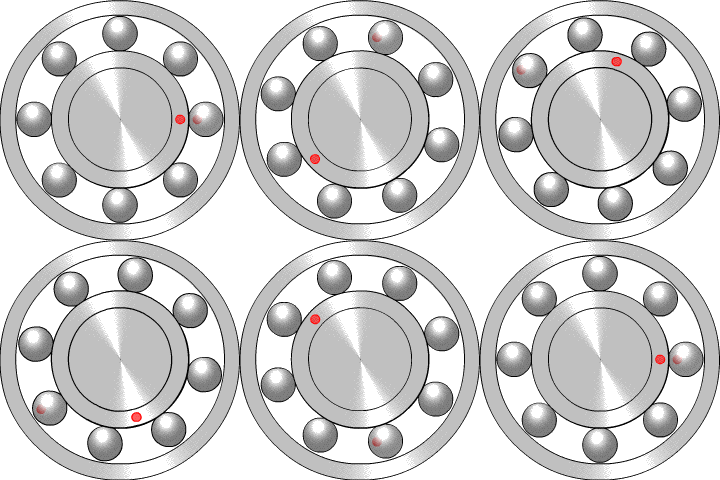
A bearing is a device to allow constrained relative motion between two or more parts, typically rotation or linear movement. Bearings may be classified broadly according to the motions they allow and according to their principle of operation as well as by the directions of applied loads they can handle.

Bearing friction

Plain bearings are simply a hole of the correct shape containing the relatively moving part, and use surfaces in rubbing contact, often with a lubricant such as oil or graphite. They are very widely used. Particularly with lubrication they often give entirely acceptable life and friction.

However, reducing friction in bearings is often important for efficiency, to reduce wear and to facilitate extended use at high speeds and to avoid overheating and premature failure of the bearing. Essentially, a bearing can reduce friction by virtue of its shape, by its material, or by introducing and containing a fluid between surfaces or by separating the surfaces with an electromagnetic field.

By shape, gains advantage usually by using spheres or rollers, or by forming flexure bearings.
By material, exploits the nature of the bearing material used. (An example would be using plastics that have low surface friction.)

By fluid, exploits the low viscosity of a layer of fluid, such as a lubricant or as a pressurized medium to keep the two solid parts from touching, or by reducing the normal force between them.

By fields, exploits electromagnetic fields, such as magnetic fields, to keep solid parts from touching.

Combinations of these can even be employed within the same bearing. An example of this is where the cage is made of plastic, and it separates the rollers/balls, which reduce friction by their shape and finish.


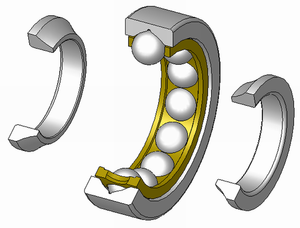
An example of a four-point contact ball bearing.

Creative Commons: Wikipedia

Axle


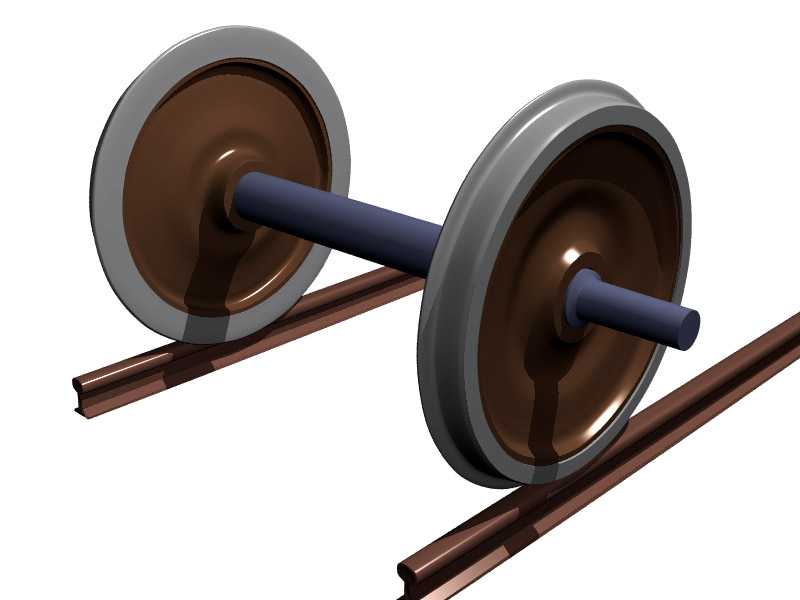
Train wheels are affixed to a straight axle, such that both wheels rotate in unison. This is called a wheelset.

An axle is a central shaft for a rotating wheel or gear. In some cases the axle may be fixed in position with a bearing or bushing sitting inside the hole in the wheel or gear to allow the wheel or gear to rotate around the axle. In other cases the wheel or gear may be fixed to the axle, with bearings or bushings provided at the mounting points where the axle is supported. Sometimes, especially on bicycles, the latter type is referred to as a spindle.

Creative Commons: Wikipedia

Wedge


Wood Splitting Wedge

A wedge is a triangular shaped tool, a compound and portable inclined plane, and one of the six classical simple machines. It can be used to separate two objects or portions of an object, lift an object, or hold an object in place. It functions by converting a force applied to its blunt end into forces perpendicular (normal) to its inclined surfaces. The mechanical advantage of a wedge is given by the ratio of the length of its slope to its width. Although a short wedge with a wide angle may do a job faster, it requires more force than a long wedge with a narrow angle.


Cross-section of a splitting wedge with its length oriented vertically. A downward force produces forces perpendicular to its inclined surfaces.

Creative Commons : Wikipedia

Screw


A screw is one of the six simple machines. All screws are helical inclined planes. A screw can convert a rotational force (torque) to a linear force and vice versa. The ratio of threading determines the mechanical advantage of the machine. More threading increases the mechanical advantage. A rough comparison of mechanical advantage can be done by taking the circumference of the shaft of the screw and divide by the distance between the threads.

A screw is a shaft with a helical groove or thread formed on its surface and provision at one end to turn the screw. Its main uses are as a threaded fastener used to hold objects together, and as a simple machine used to translate torque into linear force. It can also be defined as an inclined plane wrapped around a shaft.

Screws come in a variety of shapes and sizes for different purposes.

Belt and Pulley Systems


A belt and pulley system is characterized by two or more pulleys in common to a belt. This allows for mechanical power, torque, and speed to be transmitted across axes and, if the pulleys are of differing diameters, a mechanical advantage to be realized.

A belt drive is analogous to that of a chain drive, however a belt sheave may be smooth (devoid of discrete interlocking members as would be found on a chain sprocket, spur gear, or timing belt) so that the mechanical advantage is approximately given by the ratio of the pitch diameter of the sheaves only, not fixed exactly by the ratio of teeth as with gears and sprockets.

In the case of a drum-style pulley, without a groove or flanges, the pulley often is slightly convex to keep the flat belt centered. Though once widely used in factory line shafts, this type of pulley is still found driving the rotating brush in upright vacuum cleaners.

Creative Commons: Wikipedia

Pulley


A pulley, also called a sheave or a drum, is a mechanism composed of a wheel on an axle or shaft that may have a groove between two flanges around its circumference. A rope, cable, belt, or chain usually runs over the wheel and inside the groove, if present. Pulleys are used to change the direction of an applied force, transmit rotational motion, or realize a mechanical advantage in either a linear or rotational system of motion. Two or more pulleys together are called a block and tackle.

Creative Commons: Wikipedia

Lever


Levers can be used to exert a large force over a small distance at one end by exerting only a small force over a greater distance at the other.

In physics, a lever (from French lever, "to raise", c.f. a levant) is a rigid object that is used with an appropriate fulcrum or pivot point to multiply the mechanical force that can be applied to another object. This leverage is also termed mechanical advantage, and is one example of the principle of moments. A lever is one of the six simple machines. Archimedes once said, "Give me a lever long enough and a fulcrum on which to place it, and I shall move the world." First class levers are similar but not the same as second or third class levers, in which the fulcrum, resistance, and effort are in different locations.

Creative Commons: Wikipedia

Machine


A machine is any device that uses energy to perform some activity. In common usage, the meaning is that of a device having parts that perform or assist in performing any type of work. A simple machine is a device that transforms the direction or magnitude of a force without consuming any energy. The word "machine" is derived from the Latin word machina.

Historically, a device required moving parts to be classified as a machine; however, the advent of electronics technology has led to the development of devices without moving parts that are considered machines—the computer being the most obvious example.

"Engines" are machines that convert heat or other forms of energy into mechanical energy. For example, in an internal combustion engine the expansion of gases caused by the heat from an exothermic chemical reaction results in a force being applied to a movable component, such as a piston or turbine blade.

Machines are ubiquitous in a wide variety of industrial, commercial, residential and transportation applications. Those employing hydraulics are especially useful in manufacturing and construction.

Creative Commons: Wikipedia

Oil Refinery


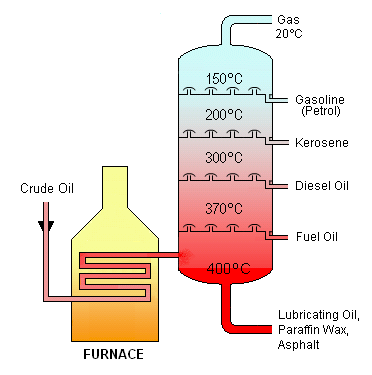
Crude oil is separated into fractions by fractional distillation. The fractions at the top of the fractionating column have lower boiling points than the fractions at the bottom. The heavy bottom fractions are often cracked into lighter, more useful products. All of the fractions are processed further in other refining units.

An oil refinery is an industrial process plant where crude oil is processed and refined into more useful petroleum products, such as gasoline, diesel fuel, asphalt base, heating oil, kerosene and liquefied petroleum gas. Oil refineries are typically large sprawling industrial complexes with extensive piping running throughout, carrying streams of fluids between large chemical processing units.

Operation

Raw or unprocessed crude oil is not generally useful. Although "light, sweet" (low viscosity, low sulfur) crude oil has been used directly as a burner fuel for steam vessel propulsion, the lighter elements form explosive vapors in the fuel tanks and are therefore hazardous, especially in warships. Instead, the hundreds of different hydrocarbon molecules in crude oil are separated in a refinery into components which can be used as fuels, lubricants, and as feedstock in petrochemical processes that manufacture such products as plastics, detergents, solvents, elastomers and fibers such as nylon and polyesters.

Petroleum fossil fuels are burned in internal combustion engines to provide power for ships, automobiles, aircraft engines, lawn mowers, chainsaws, and other machines. Different boiling points allow the hydrocarbons to be separated by distillation. Since the lighter liquid products are in great demand for use in internal combustion engines, a modern refinery will convert heavy hydrocarbons and lighter gaseous elements into these higher value products.

Oil can be used in a variety of ways because it contains hydrocarbons of varying molecular masses, forms and lengths such as paraffins, aromatics, naphthenes (or cycloalkanes), alkenes, dienes, and alkynes. While the molecules in crude oil include different atoms such as sulfur and nitrogen, the hydrocarbons are the most common form of molecules, which are molecules of varying lengths and complexity made of hydrogen and carbon atoms, and a small number of oxygen atoms. The differences in the structure of these molecules account for their varying physical and chemical properties, and it is this variety that makes crude oil useful in a broad range of applications.

Once separated and purified of any contaminants and impurities, the fuel or lubricant can be sold without further processing. Smaller molecules such as isobutane and propylene or butylenes can be recombined to meet specific octane requirements by processes such as alkylation, or less commonly, dimerization. Octane grade of gasoline can also be improved by catalytic reforming, which involves removing hydrogen from hydrocarbons producing compounds with higher octane ratings such as aromatics. Intermediate products such as gasoils can even be reprocessed to break a heavy, long-chained oil into a lighter short-chained one, by various forms of cracking such as fluid catalytic cracking, thermal cracking, and hydrocracking. The final step in gasoline production is the blending of fuels with different octane ratings, vapor pressures, and other properties to meet product specifications.

Oil refineries are large scale plants, processing about a hundred thousand to several hundred thousand barrels of crude oil a day. Because of the high capacity, many of the units operate continuously, as opposed to processing in batches, at steady state or nearly steady state for months to years. The high capacity also makes process optimization and advanced process control very desirable.


Creative Commons: Wikipedia

Tunnel Thrusters


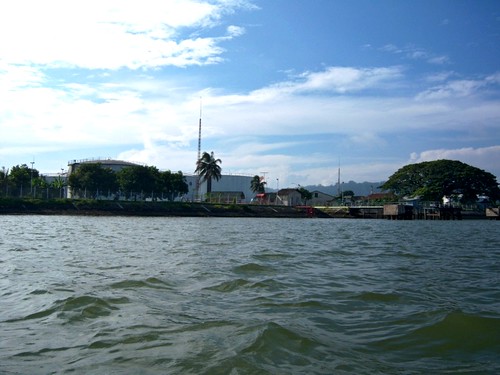
Large vessels usually have one or more tunnels built into the bow below the waterline. An impeller in the tunnel can create thrust in either direction which makes the ship turn. Most tunnel thrusters are driven by electric motors, but some are hydraulically powered. These bow thrusters, also known as tunnel thrusters, may allow the ship to dock without the assistance of tugboats, saving the costs of such service. Ships equipped with tunnel thrusters typically have a sign above the waterline over each thruster on both sides, a big white cross in a white circle.

Tunnel thrusters increase the vessel's resistance to forward motion through the water, but this can be mitigated through proper fairing aft of the tunnel aperture (see below photo). Ship operators should take care to prevent fouling of the tunnel and impeller, either through use of a protective grate or by cleaning. During vessel design, it is important to determine whether tunnel emergence above the water surface is commonplace in heavy seas. Tunnel emergence hurts thruster performance, and may damage the thruster and the hull around it.

Rolls-Royce Merlin


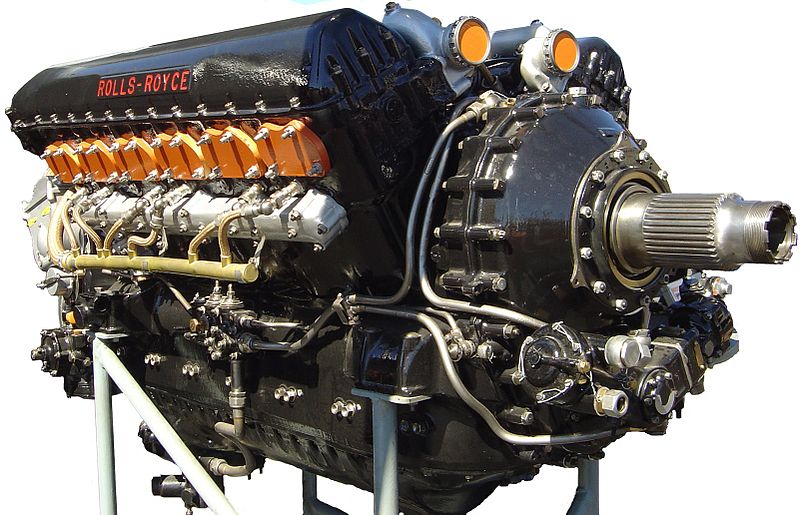
The Rolls-Royce Merlin is a British, liquid-cooled, 27-litre (1,650 cu in) capacity, V-12 piston aero engine, designed and built by Rolls-Royce Limited. Initially known as the PV-12, Rolls-Royce named the engine the Merlin following the company convention of naming its piston aero engines after birds of prey.

The PV-12 first ran in 1933, and a series of rapidly applied developments brought about by wartime needs improved the engine's performance markedly. The first operational aircraft to enter service using the Merlin were the Fairey Battle, Hawker Hurricane and Supermarine Spitfire. More Merlins were made for the four-engined Avro Lancaster heavy bomber than any other aircraft; however, the engine is most closely associated with the Spitfire and powered its maiden flight in 1936.

An English icon, the Merlin was one of the most successful aircraft engines of the World War II era, and many variants were built by Rolls-Royce in Derby, Crewe and Glasgow, as well as by Ford of Britain in Trafford Park, Manchester. The Packard V-1650 was a version of the Merlin built in the United States. Production ceased in 1950 after a total of almost 150,000 engines had been delivered, the later variants being used for airliners and military transport aircraft.
In military use the Merlin was superseded by its larger capacity stablemate, the Rolls-Royce Griffon. Merlin engines remain in Royal Air Force service today with the Battle of Britain Memorial Flight, and power many restored aircraft in private ownership worldwide.

Analog Computers


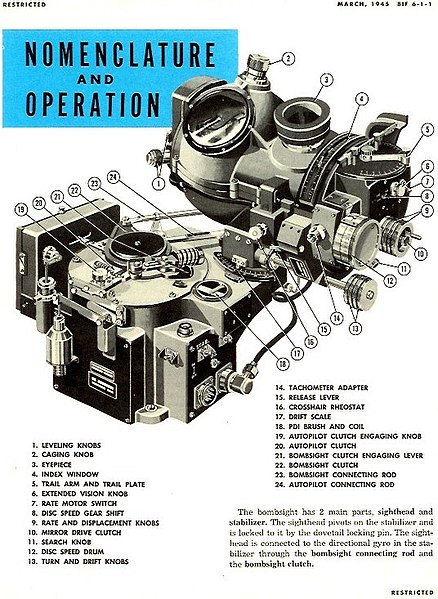
A page from the Bombardier's Information File (BIF) that describes the components and controls of the Norden bombsight. The Norden bombsight was a highly sophisticated optical/mechanical analog computer used by the United States Army Air Force during World War II, the Korean War, and the Vietnam War to aid the pilot of a bomber aircraft in dropping bombs accurately.

An analog computer (spelled analogue in British English) is a form of computer that uses the continuously-changeable aspects of physical phenomena such as electrical, mechanical, or hydraulic quantities to model the problem being solved. In contrast, digital computers represent varying quantities incrementally, as their numerical values change.

Mechanical analog computers were very important in gun fire control in World War II and the Korean War; they were made in significant numbers. In particular, development of transistors made electronic analog computers practical, and before digital computers had developed sufficiently, they were commonly used in science and industry.

Analog computers can have a very wide range of complexity. Slide rules and nomographs are the simplest, while naval gun fire control computers and large hybrid digital/analogue computers were among the most complicated. Digital computers have a certain minimum (and relatively great) degree of complexity that is far greater than that of the simpler analog computers. This complexity is required to execute their stored programs, and in many instances for creating output that is directly suited to human use.

Setting up an analog computer required scale factors to be chosen, along with initial conditions – that is, starting values. Another essential was creating the required network of interconnections between computing elements. Sometimes it was necessary to re-think the structure of the problem so that the computer would function satisfactorily. No variables could be allowed to exceed the computer's limits, and differentiation was to be avoided, typically by rearranging the "network" of interconnects, using integrators in a different sense.

Running an electronic analog computer, assuming a satisfactory setup, started with the computer held with some variables fixed at their initial values. Moving a switch released the holds and permitted the problem to run. In some instances, the computer could, after a certain running time interval, repeatedly return to the initial-conditions state to reset the problem, and run it again.

Creative Commons: Wikipedia

Electronic


Electronics is a branch of science and technology that deals with the controlled flow of electrons. The ability to control electron flow is usually applied to information handling or device control. Electronics is distinct from electrical science and technology, which deals with the generation, distribution, control and application of electrical power. This distinction started around 1906 with the invention by Lee De Forest of the triode, which made electrical amplification possible with a non-mechanical device. Until 1950 this field was called "radio technology" because its principal application was the design and theory of radio transmitters, receivers and vacuum tubes.

Most electronic devices today use semiconductor components to perform electron control. The study of semiconductor devices and related technology is considered a branch of physics, whereas the design and construction of electronic circuits to solve practical problems come under electronics engineering. This article focuses on engineering aspects of electronics.

Hydraulic Machine


Hydraulic machinery are machines and tools which use fluid power to do work. Heavy equipment is a common example.

In this type of machine, high-pressure liquid — called hydraulic fluid — is transmitted throughout the machine to various hydraulic motors and hydraulic cylinders. The fluid is controlled directly or automatically by control valves and distributed through hoses and tubes.
The popularity of hydraulic machinery is due to the very large amount of power that can be transferred through small tubes and flexible hoses, and the high power density and wide array of actuators that can make use of this power.

Hydraulic machinery is operated by the use of hydraulics, where a liquid is the powering medium. Pneumatics, on the other side, is based on the use of a gas as the medium for power transmission, generation and control.

Electric Motor


An electric motor is a motor that uses electrical energy to produce mechanical energy, usually through the interaction of magnetic fields and current-carrying conductors. The reverse process, producing electrical energy from mechanical energy, is accomplished by a generator or dynamo. Traction motors used on vehicles often perform both tasks. Electric motors can be run as generators and vice versa, although this is not always practical. Electric motors are ubiquitous, being found in applications as diverse as industrial fans, blowers and pumps, machine tools, household appliances, power tools, and disk drives. They may be powered by direct current (for example a battery powered portable device or motor vehicle), or by alternating current from a central electrical distribution grid. The smallest motors may be found in electric wristwatches. Medium-size motors of highly standardized dimensions and characteristics provide convenient mechanical power for industrial uses. The very largest electric motors are used for propulsion of large ships, and for such purposes as pipeline compressors, with ratings in the millions of watts. Electric motors may be classified by the source of electric power, by their internal construction, and by their application.

The physical principle of production of mechanical force by the interactions of an electric current and a magnetic field was known as early as 1821. Electric motors of increasing efficiency were constructed throughout the 19th century, but commercial exploitation of electric motors on a large scale required efficient electrical generators and electrical distribution networks.

By convention, electric engine refers to a railroad electric locomotive, rather than an electric motor.

Wednesday, November 25, 2009

Manufacturing


Manufacturing is the use of machines, tools and labor to make things for use or sale. The term may refer to a range of human activity, from handicraft to high tech, but is most commonly applied to industrial production, in which raw materials are transformed into finished goods on a large scale. Such finished goods may be used for manufacturing other, more complex products, such as household appliances or automobiles, or sold to wholesalers, who in turn sell them to retailers, who then sell them to end users - the "consumers".

Manufacturing takes turns under all types of economic systems. In a free market economy, manufacturing is usually directed toward the mass production of products for sale to consumers at a profit. In a collectivist economy, manufacturing is more frequently directed by the state to supply a centrally planned economy. In free market economies, manufacturing occurs under some degree of government regulation.

Modern manufacturing includes all intermediate processes required for the production and integration of a product's components. Some industries, such as semiconductor and steel manufacturers use the term fabrication instead.

The manufacturing sector is closely connected with engineering and industrial design. Examples of major manufacturers in the United States include General Motors Corporation, Ford Motor Company, Chrysler, Boeing, Gates Corporation and Pfizer. Examples in Europe include Airbus, Daimler, BMW, Fiat, and Michelin Tyre.

Source: Wikipedia

Tuesday, November 24, 2009

Automobile


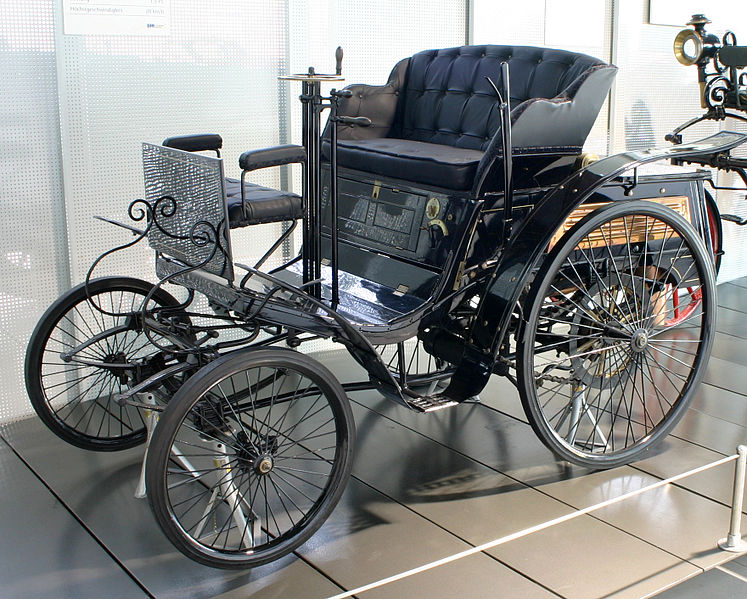
An automobile, motor car or car is a wheeled motor vehicle used for transporting passengers, which also carries its own engine or motor. Most definitions of the term specify that automobiles are designed to run primarily on roads, to have seating for one to eight people, to typically have four wheels, and to be constructed principally for the transport of people rather than goods. However, the term automobile is far from precise, because there are many types of vehicles that do similar tasks.

As of 2002, there were 590 million passenger cars worldwide (roughly one car per eleven people). Around the world, there were about 806 million cars and light trucks on the road in 2007; they burn over 260 billion gallons of gasoline and diesel fuel yearly. The numbers are increasing rapidly, especially in China and India.

Source: Wikipedia